What Are Macros, and Why Track Them?
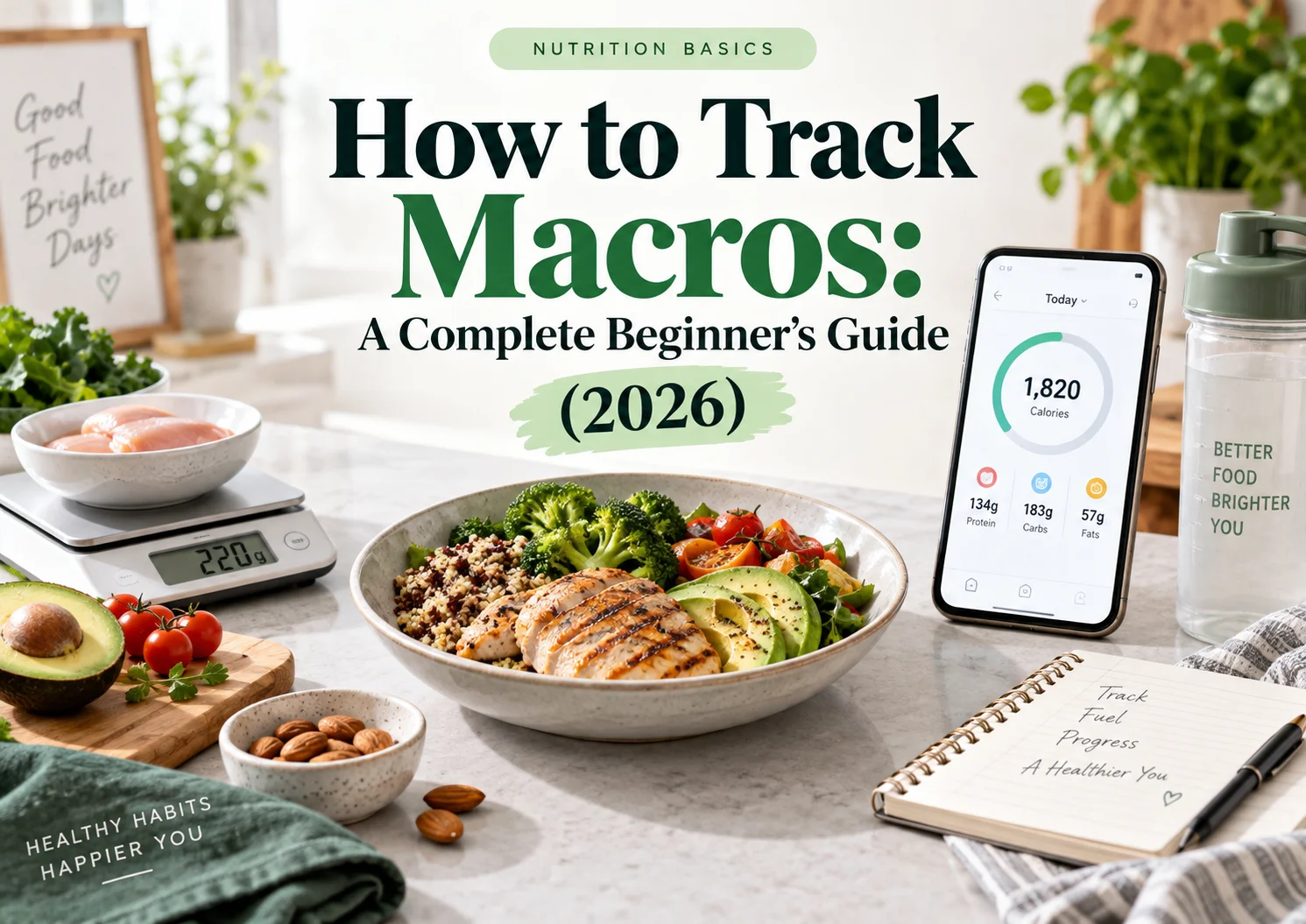
"Macros" is short for macronutrients: the three nutrients your body needs in large amounts and gets energy from. Every food you eat is some combination of them.
| Macronutrient | Energy per gram | Main roles |
|---|---|---|
| Protein | 4 kcal | Muscle repair and growth, enzymes, hormones, satiety |
| Carbohydrates | 4 kcal | Primary fuel for the brain and high-intensity exercise |
| Fat | 9 kcal | Hormone production, vitamin absorption, long-duration energy |
These energy values are known as the Atwater factors and are the basis of nearly every nutrition label and food database in the world.
Calorie counting tells you how much you're eating. Macro tracking tells you what those calories are made of. Two people can both eat 2,000 calories a day, but one of them might be getting 60 grams of protein and the other 160 grams, and their results over a few months will typically look very different.
Research consistently links dietary self-monitoring with better outcomes. A systematic review published in the Journal of the American Dietetic Association (Burke et al., 2011) found a significant association between self-monitoring and weight loss across the studies examined. A later study in Obesity (Harvey et al., 2019) found that participants who logged their food most consistently lost the most weight, and, importantly, that the time spent logging dropped sharply after the first month as people became more efficient.
In other words, tracking works partly because it teaches you what's actually on your plate.
Who Should Track Macros?
Macro tracking is generally most useful if you:
- Want to lose fat while keeping as much muscle as possible
- Are trying to build muscle and keep hearing "eat more protein" without knowing what that means in numbers
- Have plateaued on plain calorie counting
- Are an athlete or endurance trainee who needs enough carbohydrate to perform
- Simply want to understand your eating habits with real data
It is generally not a good fit if you have a history of disordered eating, or if you find that numbers make your relationship with food worse. In that case, a registered dietitian can help you find an approach that works for you, and this guide should be read as general information rather than personal advice.
Step 1: Calculate Your Daily Calorie Target
Macros are percentages or gram amounts of your total calories, so you need a calorie target first.
Estimate your BMR
Your basal metabolic rate (BMR) is roughly what your body burns at complete rest. The Mifflin-St Jeor equation is the most widely recommended formula for the general population, and studies have found it to be more accurate than the older Harris-Benedict equation for most people.
- Men: BMR = (10 × weight in kg) + (6.25 × height in cm) − (5 × age) + 5
- Women: BMR = (10 × weight in kg) + (6.25 × height in cm) − (5 × age) − 161
Example: a 35-year-old woman, 165 cm, 68 kg: (10 × 68) + (6.25 × 165) − (5 × 35) − 161 = 680 + 1031 − 175 − 161 = 1,375 kcal
Multiply by an activity factor
| Activity level | Multiplier |
|---|---|
| Sedentary (desk job, little exercise) | 1.2 |
| Lightly active (1–3 workouts/week) | 1.375 |
| Moderately active (3–5 workouts/week) | 1.55 |
| Very active (6–7 workouts/week or physical job) | 1.725 |
Our example, moderately active: 1,375 × 1.55 ≈ 2,130 kcal. This is her estimated maintenance calories, or TDEE (total daily energy expenditure).
Adjust for your goal
- Fat loss: subtract 300–500 kcal (roughly 0.25–0.5 kg per week for most people)
- Maintenance: keep TDEE as is
- Muscle gain: add 200–300 kcal
Most people overestimate their activity level. If you're unsure, pick the lower multiplier. You'll adjust based on real data in Step 4 anyway.
For a deeper walkthrough of every input in this calculation, see our guide to how a macro calculator actually works.
Step 2: Set Your Macro Targets
Start with protein
Protein is the macro to get right first, because it has the largest effect on muscle retention and satiety.
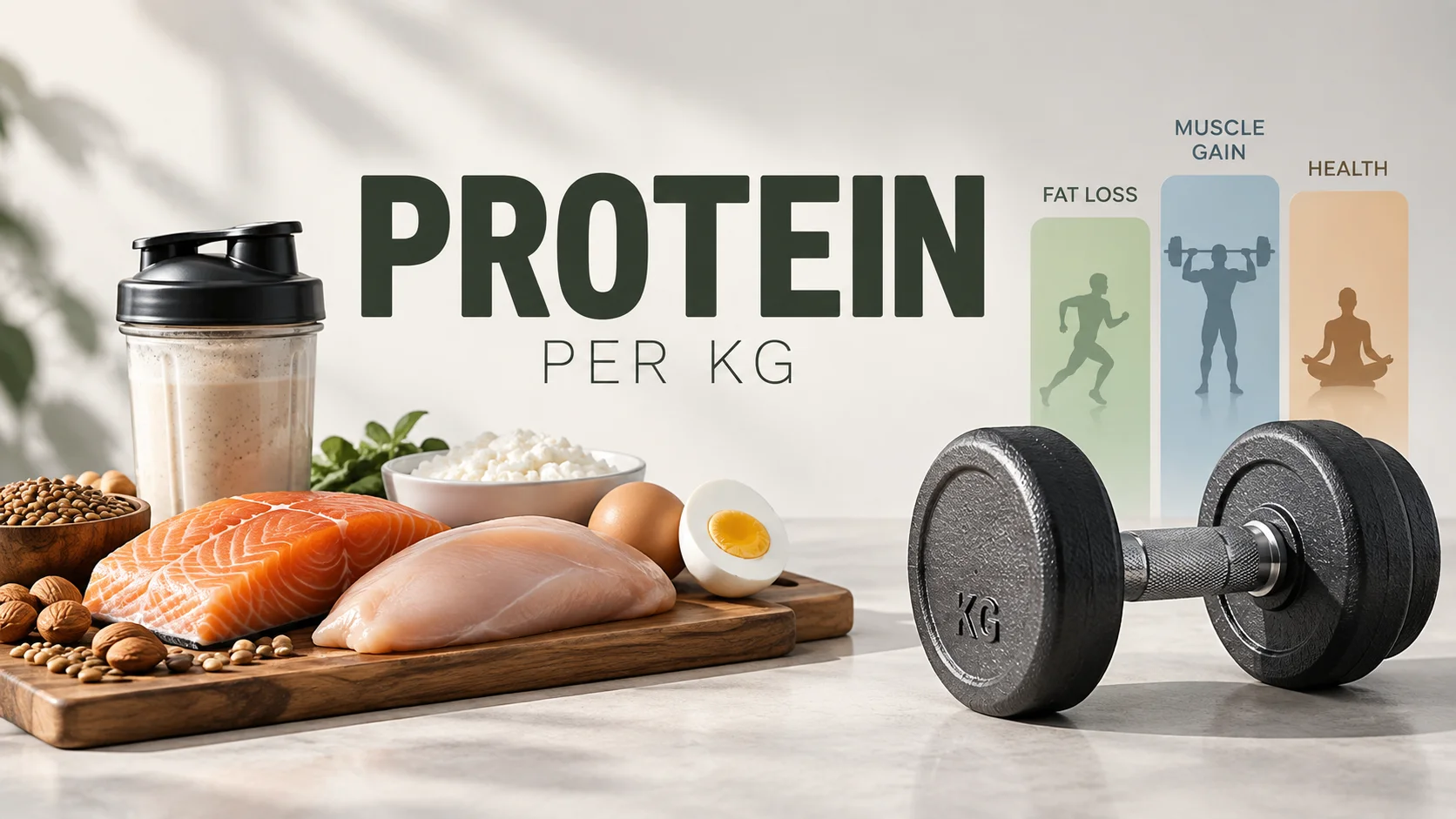
The Recommended Dietary Allowance (RDA) is 0.8 g per kg of body weight per day. It's important to understand that this is the amount needed to prevent deficiency in sedentary adults, not the amount that optimizes body composition.
For people who exercise, the evidence points higher:
- A 2018 meta-analysis in the British Journal of Sports Medicine (Morton et al.) covering 49 studies found that protein supplementation improved gains in muscle mass and strength during resistance training, with benefits plateauing at around 1.6 g/kg/day.
- The International Society of Sports Nutrition's position stand recommends 1.4–2.0 g/kg/day for most exercising individuals, and notes that higher intakes may help preserve muscle during a calorie deficit.
A practical range for most active adults is 1.6–2.2 g/kg of body weight. Our example (68 kg, fat-loss goal): 68 × 1.8 ≈ 122 g protein = 488 kcal.
We break this down further in how much protein per kg you actually need.
Set fat
Dietary fat is essential for hormone production and absorbing vitamins A, D, E and K. Going too low, typically below about 20% of calories, is associated with hormonal disruption in some studies, particularly in women.
The Acceptable Macronutrient Distribution Range (AMDR) from the U.S. National Academies puts fat at 20–35% of total calories. A simple default is 25–30%.
Example: 1,700 kcal target (2,130 − 430 deficit) × 0.28 ≈ 476 kcal ÷ 9 ≈ 53 g fat.
Fill the rest with carbohydrates
Carbs are the flexible macro. Whatever calories remain after protein and fat go here.
1,700 − 488 (protein) − 476 (fat) = 736 kcal ÷ 4 ≈ 184 g carbs.
The AMDR for carbohydrates is 45–65% of calories, but people on higher-protein plans often land below that, and that's fine as long as you're eating enough fiber and feel good during training.
Common macro splits
| Goal | Protein | Fat | Carbs | Notes |
|---|---|---|---|---|
| Fat loss (general) | 30–35% | 25–30% | 35–45% | High protein protects muscle |
| Muscle gain | 25–30% | 20–25% | 45–55% | Carbs fuel harder training |
| Endurance training | 20–25% | 20–25% | 50–60% | Glycogen is the priority |
| Low-carb / keto | 25–30% | 60–70% | 5–10% | Only if it suits you |
Percentages are a starting point. Grams matter more, because a "30% protein" target on a 1,200 kcal diet is only 90 g, which may be too low for a larger person. Always sanity-check protein in g/kg.
Not sure whether your setup should lean toward cutting or building? Read macros for weight loss vs muscle gain.
Step 3: Log Your Food Accurately
This is where most people give up, and where most tracking errors happen. A few principles make the difference.
Weigh, don't estimate (at least at first)
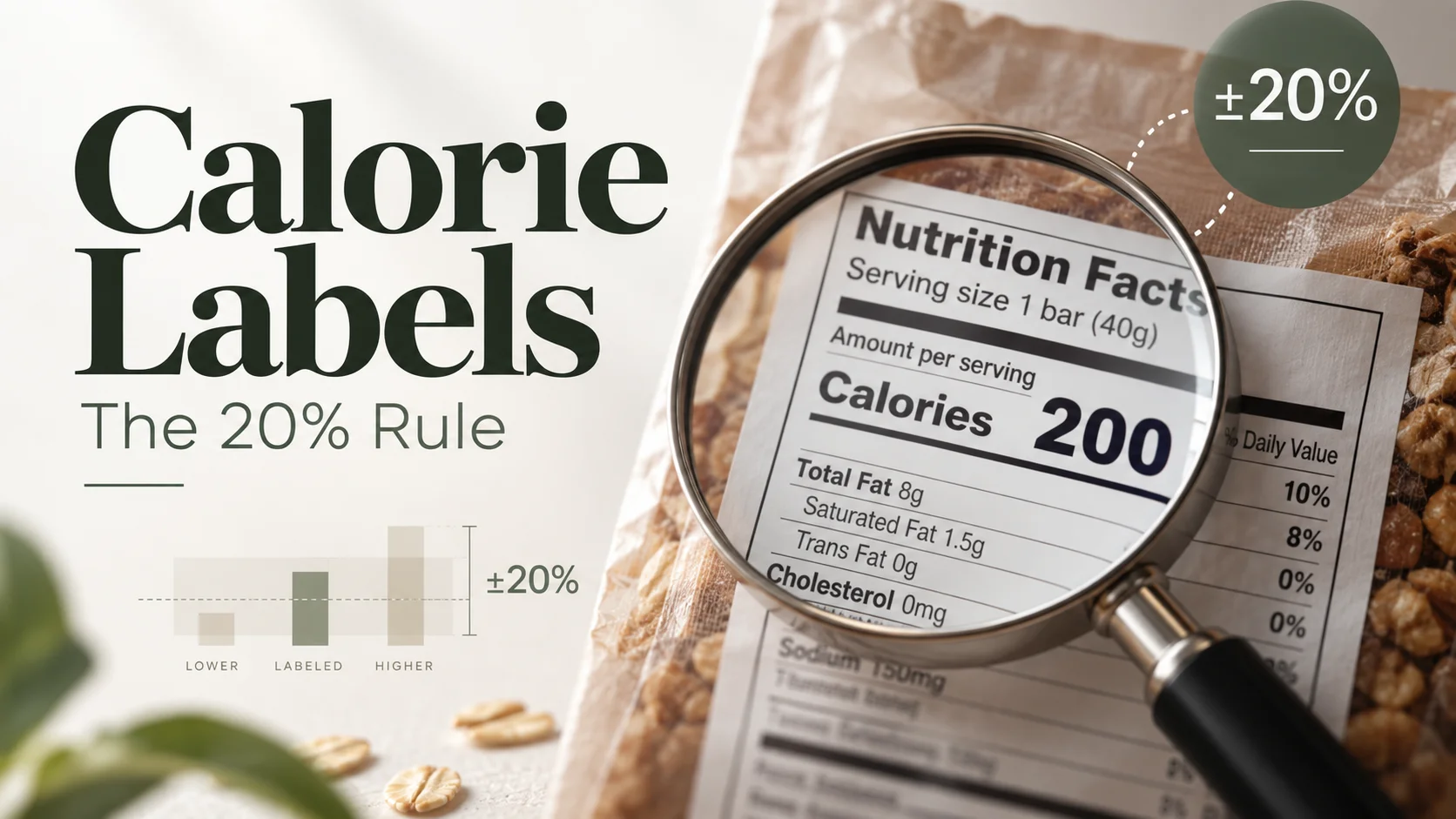
Studies of self-reported food intake, including the large NHANES surveys, consistently find that people underreport what they eat, often by 20–30% or more. A "tablespoon" of peanut butter is frequently two, and a "medium" chicken breast can weigh anywhere from 120 to 250 grams.
For the first two to four weeks, use a kitchen scale for anything calorie-dense: oils, nuts, cheese, rice, pasta, meat. You'll quickly build an accurate mental library of portion sizes, which makes the next step possible.
Learn which foods deserve precision
Not everything needs to be weighed to the gram.
- High precision: oils, butter, nut butters, nuts, cheese, dried fruit, granola, sauces
- Moderate precision: meat, fish, rice, pasta, bread, potatoes
- Low precision: leafy vegetables, cucumber, tomatoes, most non-starchy vegetables, black coffee, tea
An extra 50 g of spinach changes almost nothing. An extra tablespoon of olive oil is 120 calories.
Log raw or cooked consistently
Rice roughly triples in weight when cooked; chicken loses about 25% of its weight. Food database entries exist for both, so the trap is logging 200 g of cooked rice against a raw rice entry. Pick one convention and stick to it. Raw weights are generally more accurate, cooked weights are more convenient when eating out.
Use verified database entries
Crowd-sourced food databases are full of duplicated and incorrect entries. Whenever possible, choose entries that match the packaging label or come from an official source such as the USDA FoodData Central database. If an entry shows 0 g fat for a food that obviously contains fat, it's wrong.
Use technology where it actually helps
Barcode scanning handles packaged food well. For home-cooked and restaurant meals, photo-based logging has improved a lot: apps like CalSensei recognize dishes from a photo and estimate portions and macros, which is particularly useful for mixed dishes that don't come with a label. Photo logging is not gram-accurate, but for foods where the alternative is guessing, a consistent AI estimate tends to be closer than a rough manual guess, and it removes the friction that causes most people to stop logging.
Once you've built your portion intuition, we cover how to keep tracking honestly without a scale in tracking macros without weighing food.
Step 4: Review and Adjust Every Two Weeks
Your calculated targets are an estimate. Your body's response is the truth.
What to measure
- Body weight, daily if possible, using the weekly average. Daily weight swings of 1–2 kg from water, sodium and glycogen are normal and mean nothing on their own.
- Waist circumference once a week, same time, same conditions.
- Training performance: are your lifts, pace or reps going up, flat or down?
- Subjective markers: energy, sleep quality, hunger, mood.
How to adjust
| What you observe (over 2 weeks) | Likely meaning | Adjustment |
|---|---|---|
| Weight trending down 0.25–0.75 kg/week | Deficit is working | Keep going |
| Weight flat or up on a fat-loss plan | Intake is higher than estimated, or activity lower | Reduce calories by 100–150, mostly from carbs or fat |
| Weight dropping faster than 1 kg/week | Deficit too aggressive | Add 100–200 kcal back; check protein |
| Weight up 0.25–0.5 kg/week on a muscle-gain plan | Surplus is working | Keep going |
| Weight up faster than 0.5 kg/week on gain plan | Too much surplus, likely fat gain | Reduce surplus by 100–150 kcal |
| Strength dropping, constant hunger | Protein or total calories too low | Raise protein first, then calories |
Adjust one variable at a time and give it two weeks. Changing everything at once tells you nothing about what worked.
Common Macro Tracking Mistakes
Chasing perfect numbers every day. Hitting your macros within about 5–10 g of protein and 100 kcal is generally close enough. Consistency across the week matters far more than precision on any single day.
Ignoring fiber. Fiber isn't a macro, but it drives satiety and digestive health. Most dietary guidelines recommend around 25–38 g per day, and most adults get roughly half that. Vegetables, legumes, oats and whole fruit are the easy fixes.
Forgetting liquid calories and cooking fat. The oil the restaurant cooked your vegetables in, the milk in your coffee, the sauce on the side: these add up to hundreds of calories that never get logged.
Cutting fat too low. Zero-fat diets look great on a spreadsheet and feel terrible in practice. Stay above 20% of calories unless you're working with a professional.
Treating the calculator as gospel. BMR formulas have a margin of error of around ±10% for most people, and more for people with very high or low body fat. Start with the estimate, then let your two-week data override it.
Quitting after one bad day. One untracked day doesn't undo two tracked weeks. Log what you can, move on, and resume the next meal, not the next Monday.
Do You Have to Track Forever?
Generally, no. Most people find that a few months of consistent tracking teaches them enough about portion sizes and food composition that they can maintain their results with occasional check-ins rather than daily logging. Many long-term trackers move to a pattern like:
- Track strictly for 8–12 weeks while learning
- Track loosely (protein and total calories only) for a few months
- Stop tracking, and re-track for a week or two whenever weight or performance drifts
The goal of tracking is to eventually not need it.
Frequently Asked Questions
What's the difference between counting calories and tracking macros?
Counting calories tracks total energy. Tracking macros tracks where that energy comes from: protein, carbs and fat. Macro tracking includes calorie counting by definition, since the calories are simply the macros added up. It's more work but gives more control over body composition.
Which macro is most important?
For most goals, protein. It has the strongest evidence for preserving muscle during fat loss and supporting muscle gain, and it's the most filling per calorie. Once protein is set, carbs and fat can be adjusted to personal preference and training needs.
Can I track macros without a food scale?
Yes, but accuracy drops, especially for calorie-dense foods like oils and nuts. A common approach is to weigh everything for a few weeks to calibrate your eye, then estimate afterwards. Photo-based logging can also help fill the gap for meals where weighing isn't practical.
Do I need to hit my macros exactly every day?
No. Being within roughly 5–10 g of protein and about 100 calories is generally close enough. Weekly averages matter more than daily precision.
Should I track net carbs or total carbs?
Total carbs is the standard for most goals and most food databases. Net carbs (total carbs minus fiber) is mainly relevant for ketogenic diets, where fiber isn't counted toward the carbohydrate limit.
How long does it take to see results from tracking macros?
Water weight can shift within days, but meaningful changes in body composition typically take four to eight weeks to become visible. Give any plan at least two weeks of consistent tracking before judging whether it's working.
This article is for general educational purposes and is not a substitute for individualized medical or nutritional advice. If you have a medical condition, are pregnant, or have a history of disordered eating, consult a qualified healthcare professional before changing your diet.
Sources
- Burke LE, Wang J, Sevick MA. Self-monitoring in weight loss: a systematic review of the literature. Journal of the American Dietetic Association, 2011.
- Harvey J, et al. Log Often, Lose More: Electronic Dietary Self-Monitoring for Weight Loss. Obesity, 2019.
- Morton RW, et al. A systematic review, meta-analysis and meta-regression of the effect of protein supplementation on resistance training-induced gains in muscle mass and strength. British Journal of Sports Medicine, 2018.
- Jäger R, et al. International Society of Sports Nutrition Position Stand: protein and exercise. Journal of the International Society of Sports Nutrition, 2017.
- Mifflin MD, et al. A new predictive equation for resting energy expenditure in healthy individuals. American Journal of Clinical Nutrition, 1990.
- National Academies of Sciences, Engineering, and Medicine. Dietary Reference Intakes for Energy, Carbohydrate, Fiber, Fat, Fatty Acids, Cholesterol, Protein, and Amino Acids.
- U.S. Department of Agriculture. FoodData Central. https://fdc.nal.usda.gov/