The Number on the Label Is an Estimate
Calorie counting feels precise. You log a 220 kcal granola bar, a 165 kcal chicken breast, a 90 kcal apple, and the app adds it up to a number with no decimal places and no uncertainty. That precision is an illusion, and understanding why makes you a better tracker, not a worse one.
Every calorie figure you've ever seen is an estimate built on a chain of approximations: how the calories were measured, what the law allows, how much the batch varied, how the food was cooked, and finally how much your own body actually absorbed. None of these steps is wildly wrong. Together they add up to a margin most people never account for.
How Calories Are Measured in the First Place
Food calories are almost never measured directly anymore. The original method, bomb calorimetry, burns a dried sample of food in a sealed chamber and measures the heat released. It's accurate for the total chemical energy in the food, but it overstates what a human can extract, because we can't fully digest fiber, and we lose some energy in urine and digestion.
In the late 1800s the American chemist Wilbur Atwater ran digestion experiments on people and derived average values for the energy the body actually gets from each macronutrient:
| Macronutrient | Atwater factor |
|---|---|
| Protein | 4 kcal per gram |
| Carbohydrate | 4 kcal per gram |
| Fat | 9 kcal per gram |
| Alcohol | 7 kcal per gram |
Nearly every label in the world is calculated this way: measure or look up the grams of protein, carbs and fat, multiply, and add. The Atwater factors are averages across many foods and many people. For an individual food they can be off by a few percent; for fiber-rich or hard-to-digest foods, considerably more.
The Legal Margin of Error
Regulators know the numbers are estimates, so they build in tolerance.
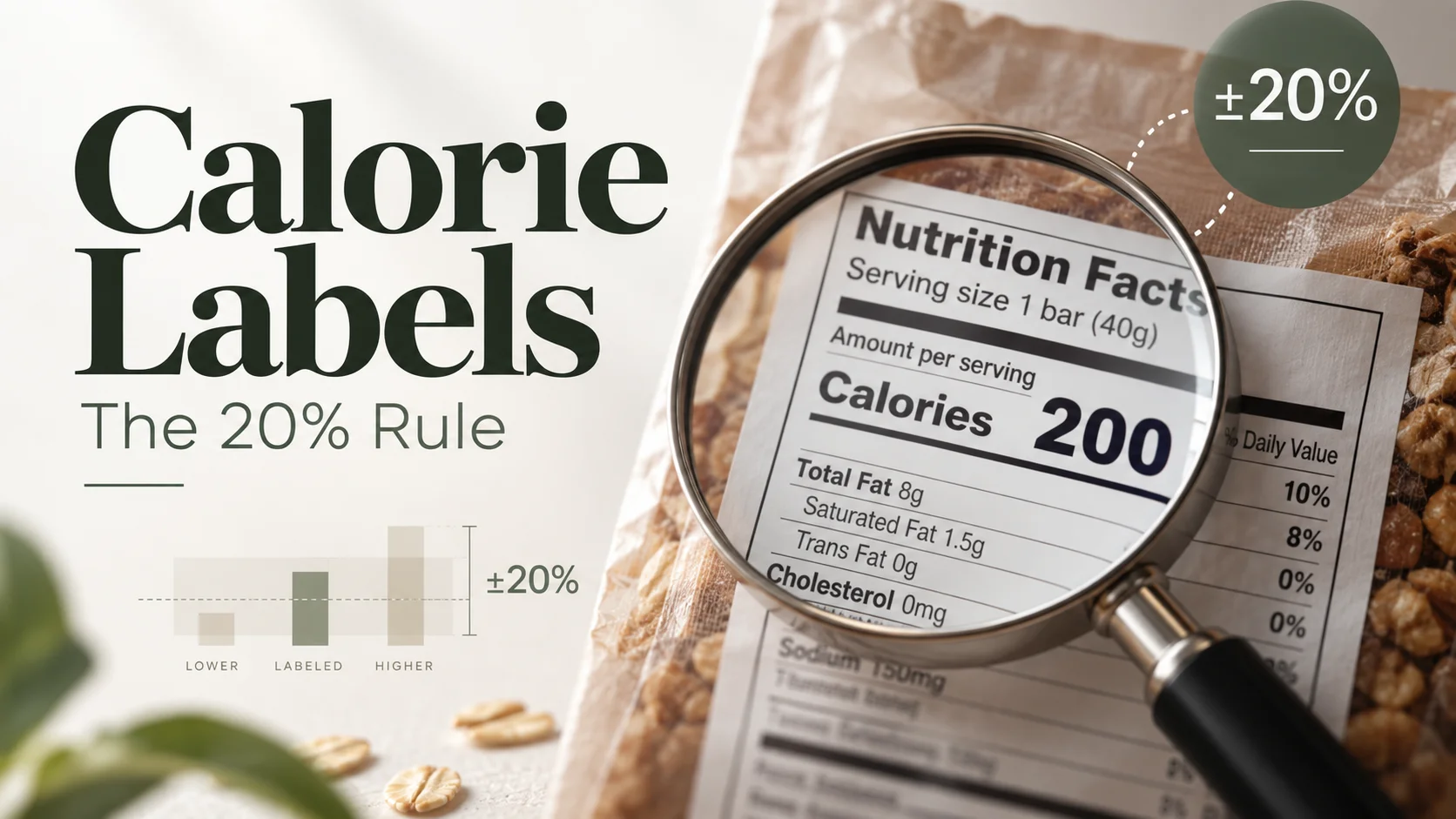
In the United States, the FDA allows the actual calorie content of a packaged food to be up to 20% higher than the label states before it's considered mislabelled. The EU uses a similar tolerance of roughly ±20% for energy. Understated calories are treated more leniently than overstated ones, since regulators are mostly concerned with consumers being misled about nutrients they want more of, like protein and vitamins.
In practice, a bar labelled 200 kcal can legally contain 240. Across a full day of packaged food, the compounding effect can be a few hundred calories if every product sits at the upper edge of tolerance. Most don't, but some do, and studies testing packaged foods find that a meaningful fraction exceed their labels.
Restaurant Menus Are Worse
Packaged food is made in controlled batches. Restaurant food is made by a person with a ladle.
A study in the Journal of the American Dietetic Association (Urban et al., 2010) had researchers purchase items from restaurants and frozen-meal brands and measure their actual energy content. Restaurant items averaged 18% more calories than the menu claimed, and frozen meals averaged 8% more. The spread was the real story: some items were accurate, and some contained more than double the stated calories.
A follow-up study of 42 chain restaurants (Urban et al., 2011, JAMA) found that while calorie counts were accurate on average, 19% of items contained at least 100 kcal more than stated, and the errors were largest in lower-calorie items, precisely the ones people order when trying to lose weight. A "light" salad listed at 350 kcal is exactly the kind of dish that arrives with an extra 150 kcal of dressing.
Independent restaurants without published calorie counts are essentially unmeasured. Any figure in a food database for "restaurant chicken curry" is a guess about a dish that varies by cook, portion and day.
Cooking Changes the Count
Two identical raw ingredients can deliver different calories depending on preparation.
Cooking breaks down cell walls and starches, making more energy available for absorption. Research by Richard Wrangham and colleagues at Harvard has shown that animals fed cooked food extract measurably more energy from it than from the same food raw. This is part of why raw-food diets tend to cause weight loss: the label calories are there, but fewer of them reach the body.
Cooking method also adds or removes calories directly. Fat rendered out of meat and left in the pan doesn't count; fat absorbed from the pan into a fried vegetable does. Labels and databases usually assume a standard method, and your kitchen may not match it.
Your Body Doesn't Absorb Everything
The final step is the one almost no one accounts for: the label measures what's in the food, not what ends up in you.
Nuts are the famous example. A study in the American Journal of Clinical Nutrition (Novotny et al., 2012) measured energy absorbed from almonds using a controlled feeding trial and found people extracted about 32% fewer calories than the Atwater calculation predicted. Similar work has found roughly 20% shortfalls for walnuts and 5% for pistachios. The fat in whole nuts is locked inside cell walls that chewing and digestion don't fully break down.
Fiber reduces net absorption. Foods high in fiber pass some of their energy through undigested. The 4 kcal per gram factor for carbohydrate includes fiber that in reality delivers closer to 2 kcal per gram, and some labelling systems already adjust for this while others don't.
Protein costs energy to digest. The thermic effect of food is the energy your body spends processing what you ate. For protein it's around 20–30% of the calories consumed; for carbohydrates around 5–10%; for fat around 0–3%. Two meals with identical calorie counts can leave you with a net difference of 50–100 kcal depending on their protein content.
Individuals vary. Gut microbiome composition, transit time and food structure all affect extraction. Two people eating the same meal can absorb slightly different amounts of energy from it.
So Is Calorie Counting Pointless?
No. The errors are real, but they're mostly consistent, and consistent errors don't matter much for tracking.
If your almonds are always 30% overstated and your restaurant meals are always 18% understated, your daily total is wrong by a stable amount. The scale still responds to the change in your intake, and your tracking still tells you which direction to move. Self-monitoring remains one of the best-supported predictors of weight-loss success in the research literature, error margins included.
What the errors do mean is that the precision most people chase is fake. Logging 87 kcal of apple versus 90 kcal is meaningless when the chicken next to it could be off by 40. The useful precision is at the level of the day and the week, not the item.
How to Track Accurately Despite the Errors
Weigh the calorie-dense foods. Oils, nuts, cheese, butter, nut butters, dried fruit and grains carry most of the error risk because small weight mistakes mean large calorie mistakes. An extra 10 g of olive oil is 90 kcal; an extra 10 g of cucumber is nothing.
Use verified entries. Prefer database entries drawn from official sources such as the USDA FoodData Central, or that match the packaging exactly. Crowd-sourced entries with round numbers or missing macros are often wrong.
Assume restaurant meals are 20% more than any listed figure. If you're logging a restaurant dish from a database or a menu, add roughly a fifth, or pick the higher of two plausible entries. This single adjustment fixes the largest systematic error most trackers have.
Log everything, including the mixed dishes. The biggest tracking error isn't a 20% margin on a labelled item; it's the untracked home-cooked stew or the restaurant plate that was too awkward to log and got skipped. For mixed dishes without a label, photo-based estimation is now a reasonable option: apps like CalSensei estimate calories and macros from a photo of the plate, with an error margin comparable to a decent restaurant label. Consistently logging a reasonable estimate beats precisely logging half your meals.
Adjust to results, not to labels. After two to three weeks of consistent tracking, compare your logged intake to what the scale did. If you logged a 500 kcal daily deficit and lost nothing, your real intake is higher than your log, whatever the labels say. Lower the target by 100–150 kcal and repeat. This feedback loop makes label errors irrelevant, because you're calibrating against the only measurement that matters. We explain the full method in our guide to tracking macros.
Don't chase the decimals. Accept a margin. Aim to be within about 100 kcal of your daily target on average and stop worrying about the rest.
Frequently Asked Questions
How accurate are calorie counts on food labels?
Labels are legally allowed to understate calories by up to 20% in the US and by a similar margin in the EU. Most packaged foods are reasonably close, but some sit at or beyond the edge of the tolerance.
Are restaurant calorie counts accurate?
On average roughly, but individual dishes vary widely. Studies have found restaurant items average around 18% more calories than stated, with lower-calorie menu items showing the largest errors.
Why do nuts have fewer calories than the label says?
The fat in whole nuts is trapped in cell walls that digestion doesn't fully break down. Controlled studies found the body absorbs about 32% fewer calories from almonds and about 20% fewer from walnuts than the label calculation suggests.
Does cooking change the calories in food?
Yes. Cooking generally makes more energy available for absorption, and cooking methods add or remove fat. Labels assume a standard preparation that may not match yours.
Should I stop counting calories if labels are inaccurate?
No. Label errors are mostly consistent, so tracking still shows the direction and size of changes in your intake. Adjust your targets based on what the scale does over two to three weeks rather than trusting the labels absolutely.
How can I count calories more accurately?
Weigh calorie-dense foods, use verified database entries, add about 20% to restaurant estimates, log every meal including mixed dishes, and calibrate your targets against your actual results.
This article is for general educational purposes and is not a substitute for individualized medical or nutritional advice. If you have a medical condition affecting digestion or nutrient absorption, consult a qualified healthcare professional.
Sources
- U.S. Food and Drug Administration. Guidance for Industry: Nutrition Labeling Manual, A Guide for Developing and Using Data Bases.
- Urban LE, et al. The accuracy of stated energy contents of reduced-energy, commercially prepared foods. Journal of the American Dietetic Association, 2010.
- Urban LE, et al. Accuracy of stated energy contents of restaurant foods. JAMA, 2011.
- Novotny JA, Gebauer SK, Baer DJ. Discrepancy between the Atwater factor predicted and empirically measured energy values of almonds in human diets. American Journal of Clinical Nutrition, 2012.
- Carmody RN, Weintraub GS, Wrangham RW. Energetic consequences of thermal and nonthermal food processing. Proceedings of the National Academy of Sciences, 2011.
- Westerterp KR. Diet induced thermogenesis. Nutrition & Metabolism, 2004.
- Merrill AL, Watt BK. Energy value of foods: basis and derivation. USDA Agriculture Handbook No. 74, 1973.