What Intermittent Fasting Is
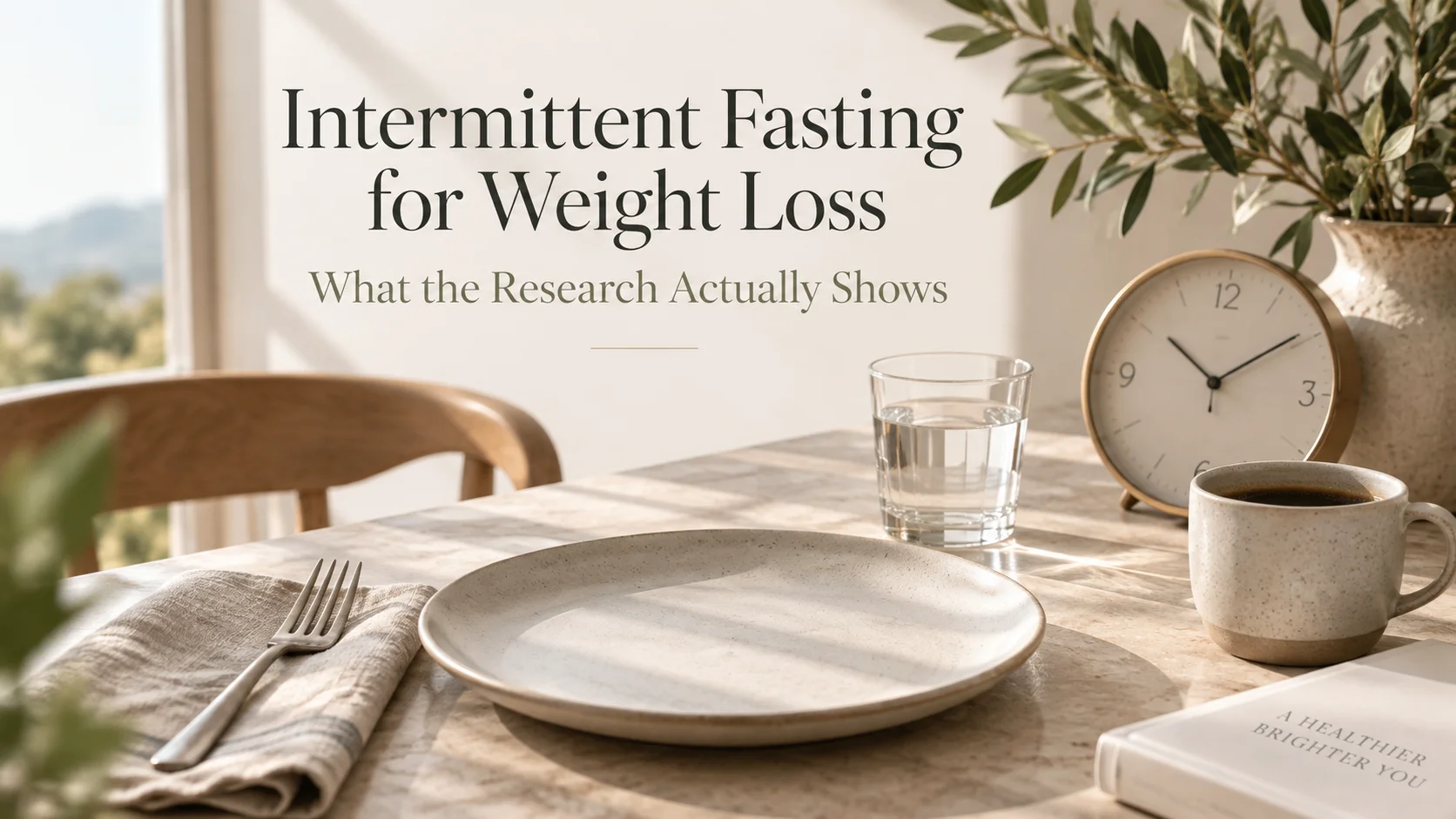
Intermittent fasting (IF) is not a diet in the usual sense. It doesn't tell you what to eat; it tells you when. All IF protocols share one idea: restrict eating to a defined window, and fast for the rest of the time.
The main versions:
| Protocol | How it works | Typical fasting period |
|---|---|---|
| 16:8 (time-restricted eating) | Eat within an 8-hour window, fast for 16 | Daily, e.g. eat 12:00–20:00 |
| 14:10 | Gentler version of 16:8 | Daily, e.g. eat 09:00–19:00 |
| 5:2 | Eat normally 5 days, ~500–600 kcal on 2 non-consecutive days | Two partial fasts per week |
| Alternate-day fasting (ADF) | Alternate normal days with fasting or ~500 kcal days | Every other day |
| OMAD (one meal a day) | Eat all daily calories in a 1–2 hour window | ~22–23 hours daily |
| Eat-Stop-Eat | One or two full 24-hour fasts per week | 24 hours, 1–2 times weekly |
16:8 is by far the most popular because it's the easiest to fit around normal life: skip breakfast, eat lunch and dinner, done.
Does Intermittent Fasting Work for Weight Loss?
Yes, for many people. But the honest answer to why it works is less exciting than the marketing.
The trials
The largest and most rigorous recent trial was published in the New England Journal of Medicine in 2022 (Liu et al.). Researchers randomised 139 adults with obesity to twelve months of either calorie restriction alone, or the same calorie restriction combined with an 8-hour eating window. Both groups lost a meaningful amount of weight, around 6–8 kg. The time-restricted group lost slightly more on average, but the difference was not statistically significant. Blood pressure, glucose, lipids and body fat improved similarly in both groups.
In other words: when calories were matched, adding a fasting window didn't add extra weight loss.
The TREAT trial (Lowe et al., 2020, JAMA Internal Medicine) tested 16:8 in 116 adults for twelve weeks without any calorie guidance, which is closer to how most people actually do it. The fasting group lost about 0.9 kg versus 0.7 kg in the control group, a difference too small to be meaningful, and the fasting group lost a somewhat larger share of lean mass. The likely reason: without instructions, people simply ate the same amount in a shorter window.
Alternate-day fasting has been tested head-to-head against daily calorie restriction over a full year (Trepanowski et al., 2017, JAMA Internal Medicine). Weight loss was essentially identical, roughly 6% of body weight in both groups, and the fasting group had a higher dropout rate.
Systematic reviews pooling dozens of trials reach the same conclusion: intermittent fasting produces weight loss comparable to conventional calorie restriction, and not reliably more.
So why does it work at all?
Because it usually reduces calorie intake. Skipping a meal removes an eating opportunity. Fewer hours of eating typically means fewer snacks, fewer late-evening calories and, for many people, less total food. Studies that track intake find that time-restricted eaters spontaneously eat around 200–500 fewer calories a day, even when told to eat freely.
Intermittent fasting is a structure for eating less, not a metabolic trick. That's not a criticism. Structure is exactly what most people are missing, and a rule that's simple to follow often beats a rule that's theoretically better. For someone who does well with clear boundaries and struggles with all-day grazing, "nothing before noon" can be the most effective diet they've ever tried.
What About the Metabolic Benefits?
This is where the claims outrun the evidence, though some are real.
Insulin sensitivity. A small but well-designed study (Sutton et al., 2018, Cell Metabolism) had men with prediabetes eat within a 6-hour window ending mid-afternoon, with calories matched to prevent weight loss. Insulin sensitivity, blood pressure and oxidative stress improved even with no weight change. This suggests an early eating window may have benefits independent of weight loss. It was a five-week study in eight people, so it's a promising signal rather than a settled fact.
Autophagy. Cellular "clean-up" processes increase during fasting, and this is often cited as a benefit. The research is largely in animals and cell cultures, and the fasting durations involved are usually far longer than 16 hours. There is currently no good human evidence that a daily 16:8 window meaningfully changes autophagy in a way that affects health.
Metabolic rate. Short fasts do not slow your metabolism, and there is some evidence that very short fasts (under 48–72 hours) may temporarily raise it slightly. Fasting also does not put you into "starvation mode." Over longer periods, any metabolic adaptation comes from weight loss itself, the same as with any diet, which we discuss in our weight loss plateau guide.
Fat burning. After roughly 12–16 hours without food, the body draws more on stored fat for fuel. This is true. It's also true that fat burned during the fast is offset by fat stored after the next meal unless total daily calories are lower. What matters over weeks is the balance, not the hours spent in one state or the other.
Who Intermittent Fasting Suits
It tends to work well if you:
- Aren't hungry in the morning and find breakfast a chore
- Snack a lot, especially in the evening
- Prefer a few large meals to many small ones
- Like simple rules and dislike counting
- Have a schedule that makes a fixed eating window easy
It tends to work poorly if you:
- Train hard early in the day and perform badly without fuel
- Get very hungry in the morning and end up overeating in the window
- Are trying to gain muscle (fitting 1.6–2.2 g/kg of protein into a short window is hard; see our protein per kg guide)
- Have a history of disordered eating, where rigid food rules can be harmful
- Are pregnant, breastfeeding, or taking medication that requires food or affects blood sugar
The last two points aren't cautionary boilerplate. Fasting can cause dangerous drops in blood sugar for people on insulin or sulfonylureas, and structured fasting is generally considered inappropriate for anyone with a history of restrictive eating.
How to Do Intermittent Fasting Well
If you decide to try it, a few things separate the people who get results from the people who don't.
Start with 14:10 or 16:8. The evidence for the extreme protocols isn't stronger, and the dropout rates are higher. An 8-hour window is enough to get the structural benefit.
Don't treat the window as a free-for-all. The trials are clear: fasting doesn't cause weight loss if you eat the same amount in less time. Watch overall intake, at least at first. Tracking for a couple of weeks shows whether the window is actually reducing calories or just compressing them. Photo-based logging apps like CalSensei make this practical, since two or three larger meals are quick to capture from a picture, and you'll see immediately whether the fasting window is doing anything.
Front-load protein. With fewer meals, each one needs to carry more protein. Aim for 40–60 g in each of your two or three meals rather than a light lunch and a heavy dinner.
Consider an earlier window. The limited evidence on metabolic benefits points toward eating earlier in the day, roughly 08:00–16:00 or 10:00–18:00, rather than the more common noon-to-eight. Late eating windows may blunt some of the insulin-related advantages. If a late window is the only one that fits your life, it will still work for weight loss.
Drink water, black coffee or plain tea during the fast. Zero-calorie drinks don't break a fast in any meaningful sense. Anything with calories does, including milk in coffee.
Give it four weeks. Hunger in the first week is normal and usually fades. If after a month you're miserable, performing worse in training or overeating in the window, it isn't the right tool for you, and that's fine. It has no special powers you'd be missing out on.
Intermittent Fasting vs Calorie Counting
Neither is better. They're different tools for producing the same result, a sustained calorie deficit.
| Intermittent fasting | Calorie counting | |
|---|---|---|
| Rule | When to eat | How much to eat |
| Effort | Very low daily effort | Moderate, drops with practice |
| Precision | Low; deficit is a side effect | High; deficit is deliberate |
| Best for | People who overeat from grazing | People who overeat from portion size |
| Muscle gain | Awkward | Straightforward |
| Failure mode | Overeating in the window | Tracking fatigue |
Many people combine them: a fixed eating window for structure, plus rough tracking to make sure the window is actually delivering a deficit. Our guide to tracking macros covers the tracking side.
Frequently Asked Questions
Does intermittent fasting work better than a regular diet?
Not according to the trials. When calories are matched, intermittent fasting and conventional calorie restriction produce similar weight loss. Its advantage is that some people find it easier to stick to.
How much weight can you lose with intermittent fasting?
In year-long trials, participants typically lost 5–8% of body weight, about the same as with daily calorie restriction. Results depend almost entirely on whether the eating window reduces your total intake.
Does coffee break a fast?
Black coffee, plain tea and water don't break a fast in any way that matters for weight loss. Milk, sugar, cream or sweetened drinks with calories do.
Is 16:8 or 5:2 better?
Neither has shown superior results. 16:8 is easier for most people to sustain daily; 5:2 suits people who prefer eating normally most days and tolerate two very low-calorie days.
Will I lose muscle with intermittent fasting?
Possibly some, especially with longer windows or without resistance training. One trial found slightly greater lean mass loss with 16:8 than with a control diet. Keeping protein high and lifting weights offsets most of the risk.
Can I exercise while fasting?
Most people can do moderate exercise fasted without issue. High-intensity or long sessions often go better with food beforehand. If performance drops noticeably, move your window or your workout.
This article is for general educational purposes and is not a substitute for individualized medical advice. Do not start fasting if you are pregnant, breastfeeding, under 18, have a history of disordered eating, or take medication for diabetes or blood pressure without consulting a qualified healthcare professional.
Sources
- Liu D, et al. Calorie Restriction with or without Time-Restricted Eating in Weight Loss. New England Journal of Medicine, 2022.
- Lowe DA, et al. Effects of Time-Restricted Eating on Weight Loss and Other Metabolic Parameters in Women and Men With Overweight and Obesity: The TREAT Randomized Clinical Trial. JAMA Internal Medicine, 2020.
- Trepanowski JF, et al. Effect of Alternate-Day Fasting on Weight Loss, Weight Maintenance, and Cardioprotection Among Metabolically Healthy Obese Adults. JAMA Internal Medicine, 2017.
- Sutton EF, et al. Early Time-Restricted Feeding Improves Insulin Sensitivity, Blood Pressure, and Oxidative Stress Even without Weight Loss in Men with Prediabetes. Cell Metabolism, 2018.
- Varady KA, et al. Clinical application of intermittent fasting for weight loss: progress and future directions. Nature Reviews Endocrinology, 2022.
- Patikorn C, et al. Intermittent Fasting and Obesity-Related Health Outcomes: An Umbrella Review of Meta-analyses of Randomized Clinical Trials. JAMA Network Open, 2021.